



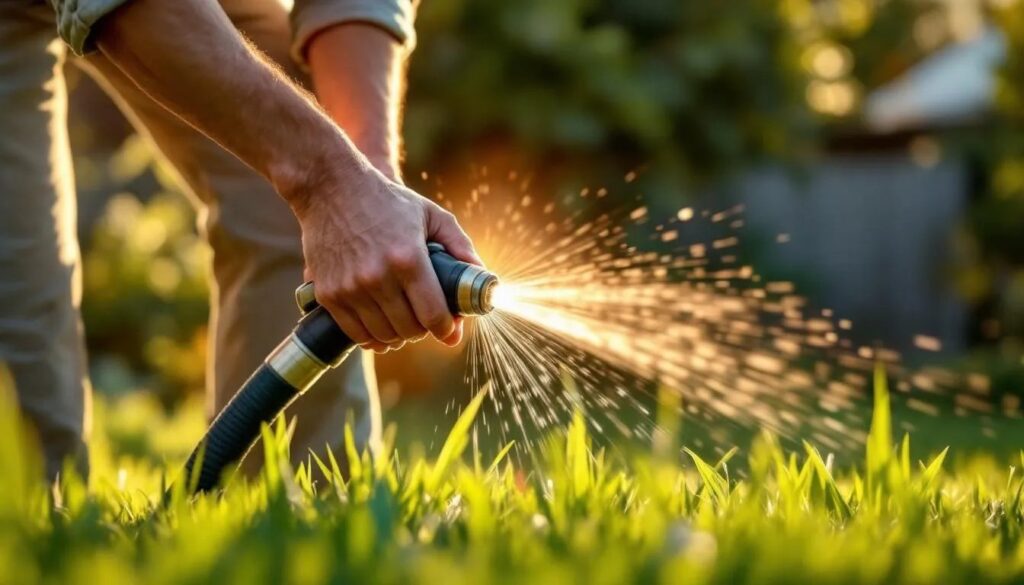
Spring is here, and as temperatures climb and daylight stretches longer, lawns across the country are waking up and demanding attention. After months of dormancy, grass needs water — but watering at the wrong time of day can quietly undo every effort you put into your lawn, encouraging disease, wasting money, and leaving turf more stressed than refreshed. The timing of irrigation matters far more than most homeowners realise, and getting it right from the start of the season sets the tone for the months ahead.
This guide cuts through the confusion and gives you a clear, science-backed answer on when to water, why it works, and how to adjust for your specific lawn conditions. Whether you rely on a basic hose-end sprinkler or a multi-zone irrigation system, the principles are the same — and the savings on your water bill will speak for themselves.
| Recommended frequency | 2–3 times per week in spring; adjust for rainfall |
| Operation duration | 20–45 minutes per zone, depending on soil type |
| Optimal season | Spring — starting mid-March through May |
| Products to avoid | Avoid high-pressure nozzles that cause runoff on compacted soil |
The Clear Winner: Early Morning
The best time to water your lawn is between 6 a.m. and 10 a.m. This window consistently outperforms any other part of the day, and the reasons are rooted in basic plant biology and environmental physics. In the early morning, temperatures are low and winds are typically calm. Water applied to turf has time to soak down through the thatch layer and reach the root zone before the sun reaches its midday intensity. The grass blades themselves dry off within a couple of hours as temperatures rise, which significantly reduces the risk of fungal diseases like dollar spot or brown patch — both of which thrive in humid, shaded conditions.
There is also a direct efficiency argument. Water lost to evaporation during a midday irrigation session can account for 20 to 30 percent of total output, according to irrigation industry estimates. In the early morning, that evaporation rate drops dramatically, meaning more of what you pay for actually reaches the roots. In a dry spring where water restrictions may already be looming, this is a practical saving with a measurable impact on your bill.
Why Midday Watering Falls Short
Watering between 10 a.m. and 4 p.m. is the least efficient approach for most lawns in temperate climates. The sun is at its strongest, ambient temperatures are highest, and wind speeds tend to peak — all three conditions conspire to steal water from your lawn before it can do any good. Beyond the efficiency loss, water droplets sitting on turf under intense sun can act as micro-lenses, concentrating light onto grass blades and contributing to scorch marks, particularly on fine-leaf varieties such as fine fescue or bentgrass.
The exception is during an unexpected heatwave or an extended period without rain where grass shows clear signs of stress — wilting, a blue-grey tint, or footprints remaining visible in the turf. In that case, a light, targeted application at midday is a reasonable emergency measure. But it should never become a routine.
Evening Watering: Convenient but Risky
Evening irrigation — generally between 4 p.m. and sunset — is a common habit, largely because it fits around work schedules. The evaporation rate is lower than midday, which makes it more water-efficient than afternoon watering. However, the fundamental problem is that grass going into the night wet is grass primed for disease. Overnight, temperatures drop, dew forms, and a lawn that was watered at 7 p.m. can remain damp for eight to ten hours. That prolonged moisture sitting on and around the crown of the grass is precisely the environment that fungal pathogens need to establish and spread.
If early morning is genuinely impossible — for instance, if you rely on manual watering and cannot be present before work — a good compromise is late afternoon, roughly between 3 p.m. and 5 p.m. in spring, when the sun still has enough energy to dry the blades before nightfall. This is a second-best option, not a substitute for the morning window.
How Long Should You Water?
Timing of day is only half the picture. Duration and depth matter just as much. Most lawns need approximately 1 inch of water per week, including rainfall. The goal is to wet the soil to a depth of 4 to 6 inches — deep enough to reach the majority of the root system. Shallow, frequent watering trains roots to stay close to the surface, where they are vulnerable to drought and heat. Deep, less frequent sessions encourage roots to grow downward, producing a more resilient lawn.
To gauge your sprinkler output, place three or four straight-sided containers — empty tuna tins work well — across the watered zone. Run your system for 15 minutes, then measure the depth collected. This gives you a reliable precipitation rate for your specific setup. Typical rotary sprinklers deliver around 0.5 inches per hour, while fixed spray heads can apply nearly double that rate, which increases runoff risk on clay-heavy soils.
Soil Type Changes the Equation
Sandy soils drain quickly and may require shorter, more frequent sessions — three times a week rather than two — to prevent the moisture from dropping below the root zone entirely. Clay soils, by contrast, absorb water slowly and can easily become saturated, leading to runoff that carries nutrients away from the lawn. On clay ground, a cycle-and-soak approach works well: water for 10 minutes, pause for 30 minutes to allow absorption, then water again. Most modern irrigation controllers have this function built in. For loam soils, which hold moisture well without waterlogging, two thorough sessions per week through spring are generally sufficient.
Smart Controllers and Seasonal Adjustments
If you run an irrigation system, a smart controller — one that connects to local weather data and adjusts run times automatically — is one of the most practical upgrades you can make. These devices can reduce outdoor water use by an estimated 15 to 50 percent compared to fixed-schedule timers, by skipping sessions after rainfall and reducing output during cooler spells. Brands including Rachio, Hunter Hydrawise, and Orbit B-hyve offer models at various price points, typically ranging from $80 to $250 for the controller unit itself, excluding installation.
In spring particularly, many homeowners over-water because they carry over the same schedule they used during peak summer. March and April bring more rainfall, lower temperatures, and slower grass growth than July — your irrigation schedule should reflect that. A rough rule: reduce your summer schedule by 30 to 40 percent as a starting point in early spring, then increase gradually as temperatures rise and rainfall becomes less reliable.
"The single biggest mistake I see homeowners make is running their irrigation on a fixed calendar regardless of season or weather. A smart controller pays for itself in a single summer — and it takes the guesswork out entirely. Set it once at the start of spring, calibrate the sensors, and let the system do the work."
Signs You Are Watering at the Wrong Time
The lawn itself will tell you when something is off. Persistent patches of gray-pink mycelium visible in the early morning — a telltale sign of Pythium blight — often indicate overnight watering on a poorly drained area. Circular yellow-brown patches with a straw-like texture in mid-spring are frequently linked to dollar spot, which flourishes in wet turf at night. Conversely, if grass blades show a distinct blue-grey cast and do not spring back when walked on, the lawn is drought-stressed and morning watering needs to increase in depth rather than frequency.
Moss encroachment in shaded areas combined with compacted, waterlogged soil after irrigation is another indicator — it points to excessive watering on ground that cannot drain effectively. Aerating the lawn in spring and top-dressing with a coarse sand-and-compost mix improves drainage significantly and allows water to reach roots rather than pool on the surface.
The Professional's Tip
In early spring, when soil temperatures are still below 10°C (50°F), grass roots are not actively absorbing water at the same rate as in summer. Resist the temptation to begin heavy irrigation just because the surface looks dry after a dry, windy March day. Push a screwdriver or a thin metal rod 6 inches into the soil — if it meets resistance before that depth, the ground needs water; if it slides in easily, hold off. Checking soil moisture this way costs nothing and prevents the overwatering that accounts for the majority of spring lawn disease issues.
Adjustments for Newly Seeded Lawns
The rules above apply to established turf. A lawn overseeded or freshly laid from seed or sod in spring operates differently. Newly germinating seed requires the top 1 inch of soil to remain consistently moist until germination, which means light, frequent watering — up to twice daily in the morning and late afternoon — rather than deep, infrequent sessions. Once seedlings reach a mowing height of around 3 inches and the root system begins to establish, you can transition to the standard deep-watering routine over the course of two to three weeks.
Is it better to water by hand or use an automated irrigation system?
Both methods can produce healthy results when timed correctly. Manual watering with a hose and adjustable sprinkler head gives you direct control and is perfectly adequate for smaller lawns up to around 200 square metres. For larger areas or when consistent scheduling is difficult to maintain — especially during busy spring weekends — an automated drip or pop-up sprinkler system connected to a timer eliminates the risk of missed sessions. The key in both cases is ensuring the timing falls within the 6–10 a.m. window whenever possible.
Does the type of grass species change the ideal watering time?
The optimal time window — early morning — holds across virtually all common lawn grass species, including Kentucky bluegrass, tall fescue, perennial ryegrass, Bermuda grass, and zoysia. Where species differ is in their overall water requirements. Warm-season grasses like Bermuda and zoysia are more drought-tolerant and typically need less frequent watering than cool-season species such as fescue or bluegrass. Always cross-reference your specific species requirements with local extension service guidelines, as regional climate variations matter.
Can I rely solely on rainfall in spring and skip irrigation entirely?
In many parts of northern Europe and the Pacific Northwest of the United States, spring rainfall is often sufficient to meet the lawn's weekly water needs without supplemental irrigation. The practical approach is to monitor your local weekly rainfall — either via a rain gauge or a smart controller's weather integration — and only irrigate when natural precipitation falls short of the 1-inch-per-week threshold. Running irrigation after significant rainfall wastes water and increases disease risk, particularly on soils with naturally moderate drainage.
How do water restrictions affect my watering schedule?
Many municipalities introduce seasonal water restrictions from late spring onward, often limiting irrigation to specific days or prohibiting daytime watering entirely. Check with your local water authority before setting up a fixed schedule. Where restrictions allow only morning or evening watering on alternate days, the morning window should always take priority. If restricted to one session every two to three days, compensate by increasing the duration of each session to maintain the weekly 1-inch target, and consider aerating to maximise infiltration efficiency.
What are the most common watering mistakes homeowners make in spring?
Over-watering in early spring before soil temperatures have fully risen is the most frequent error, closely followed by evening watering that leaves grass damp overnight. Shallow, daily watering that keeps only the top inch moist — without ever saturating the deeper root zone — produces weak, surface-dependent roots that struggle through summer dry spells. Finally, failing to adjust an irrigation controller's seasonal settings after winter means many lawns are running the same aggressive schedule in March that was appropriate in August, which leads to saturation, nutrient leaching, and unnecessary cost.