



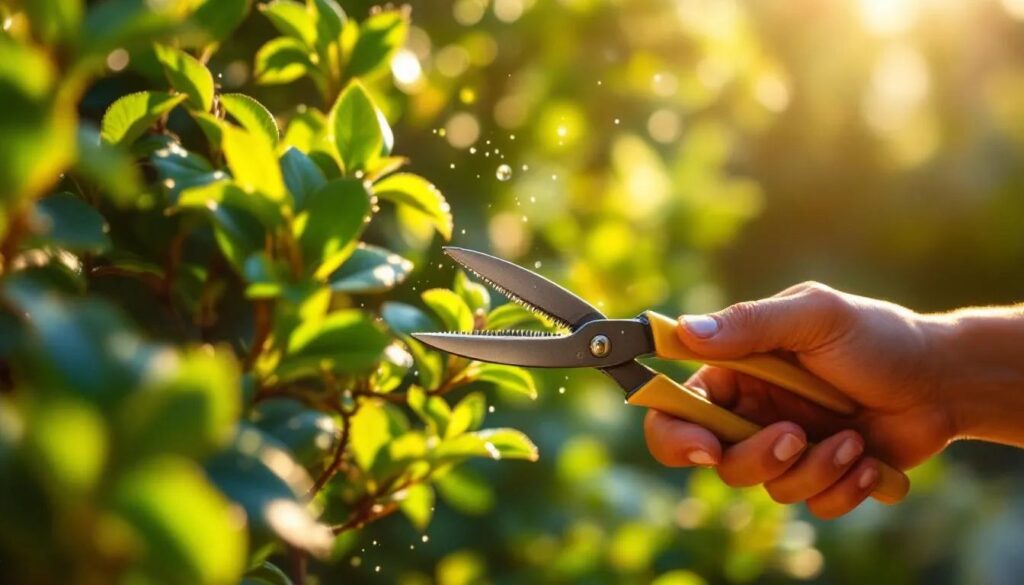
March is the sweet spot for gardeners who want their shrubs and trees to perform at their best through the growing season. The soil is warming, dormant buds are swelling, and that narrow window between the last frost and the first flush of new growth is exactly when a pair of well-sharpened secateurs can make a real difference. Pruning at the right moment — and with the right technique — determines how vigorously a plant pushes out new wood, how well it flowers, and how resistant it stays to disease over the coming months.
This guide covers the practical approach used by experienced horticulturalists and arborists: which plants to cut now, which to leave alone until later in spring, how to read the wood before making each cut, and how to avoid the most common mistakes that set plants back rather than forward. Get your gloves on.
| Time to prepare | 15–20 min (tool check and sharpening) |
| Time to complete | 1–4 hours depending on garden size |
| Difficulty | Beginner to Intermediate |
| Best season | Early to mid-spring (late March–April) |
Safety precautions: Wear cut-resistant gloves when handling thorny shrubs such as roses, pyracantha or berberis · Use safety glasses when cutting overhead branches · Work from the ground wherever possible; for any branch above head height, use a stable stepladder or consult a certified arborist · Never prune near overhead power lines without professional assistance
Understanding the timing: why spring pruning works
Plants store energy in their root systems over winter. As temperatures climb above 7–10 °C in spring, that stored energy starts moving upward through the vascular tissue. Pruning just before or during this surge means the plant directs its resources into the remaining healthy buds rather than wasting them on weak, crossing or dead wood. The result is stronger, more vigorous growth from fewer, better-placed shoots.
The timing rule differs significantly between two broad groups. Spring-bloomers — plants such as forsythia, flowering currant (Ribes sanguineum) and ornamental cherries — flower on wood produced the previous year. Pruning them now would remove this season's flower buds entirely. These should be cut immediately after flowering, typically late April through May. Summer- and autumn-bloomers — buddleja, roses, hardy fuchsia, lavatera, sambucus — flower on new growth produced this spring and summer. These benefit enormously from a hard prune right now, in late March.
Tools and supplies
Tools
- Bypass secateurs (hand pruners) — avoid anvil-type for live wood, as they crush rather than slice
- Long-handled loppers with bypass blades for stems 2–4 cm in diameter
- Pull-stroke pruning saw for branches above 4 cm
- Sharpening stone or diamond file
- 70% isopropyl alcohol or diluted bleach solution (1 part bleach to 9 parts water) for sterilising blades
Supplies
- Cut-resistant gardening gloves
- Safety glasses
- Garden twine for tying in climbing roses or wall shrubs after pruning
- Wound sealant paste (optional — see pro tip below)
- Compost or slow-release granular fertiliser for post-pruning feeding
Step-by-step: how to prune shrubs and trees in spring
1. Assess before you cut
Walk around the plant before picking up any tool. Look for the three Ds: dead wood (dry, brittle, no buds or bark), damaged wood (split, broken or frost-scorched stems, often showing as blackened or shrivelled bark at the tips), and diseased wood (cankers, unusual discolouration, dieback with no obvious physical cause). Mark these mentally — they come out first, regardless of season or species. Removing them immediately improves air circulation and prevents fungal spores from spreading once the warm, humid days of May arrive.
Then assess the overall structure. A healthy shrub should have an open, branching framework with no two main stems rubbing against each other. Crossing branches create wounds that invite disease. Identify any stems growing toward the centre of the plant rather than outward, and any suckers emerging from below the graft union on grafted roses or ornamental trees.
2. Sharpen and sterilise your tools
A blunt blade tears rather than cuts. Torn wood is slower to callus over and far more susceptible to fungal infection. Run a sharpening stone along the bevelled edge of your secateurs at a consistent angle — typically 20–25° — until the edge catches light cleanly across its full length. Then wipe the blade with a cloth soaked in isopropyl alcohol. Repeat this sterilisation step every time you move from one plant to another, particularly if any plant is showing signs of disease. This single habit prevents more problems than any other pruning technique.
3. Remove dead, damaged and diseased wood
Cut dead wood back to live tissue, identified by the green layer (cambium) just beneath the bark. On a healthy stem, a clean cut reveals a white or cream centre surrounded by a thin ring of green. If the cut surface shows brown discolouration all the way through, cut further back until you reach clean white wood. For diseased stems, make your cut at least 10–15 cm below the visible point of infection, and sterilise the blade immediately after.
4. Prune summer-flowering shrubs hard
Buddleja (Buddleja davidii), roses (hybrid teas, floribundas and shrub roses), hardy fuchsia, lavatera, caryopteris and sambucus all respond well to a firm reduction in late March. For buddleja, cut all main stems back to within 5–10 cm of last year's framework — the knobbly, thickened base of the previous season's growth. For roses, cut hybrid teas down to 4–6 buds from the base, making each cut at a 45° angle sloping away from the outward-facing bud. This angle prevents water pooling on the cut surface, which can cause rot.
The cut should be made no more than 5 mm above a bud. Too far above and the stub dies back, leaving an entry point for disease. Too close and the bud itself may be damaged. When you make the cut, you should feel — and hear — a clean, crisp snap through the secateurs. If you feel resistance and crushing, the blade needs sharpening.
5. Shape and thin spring-flowering shrubs lightly
For forsythia, ribes, deutzia and philadelphus, restrict yourself now to removing any dead, damaged or crossing stems only. The flowering wood is already set. Once they finish blooming — usually late April to early June depending on variety — cut one-third of the oldest, thickest stems right back to the base. This renewal pruning approach cycles through the plant over three years, maintaining vigour without sacrificing a season's flowers.
6. Prune trees with restraint
Most established ornamental trees need little intervention in spring beyond removing dead or crossing branches. For young trees, now is the time to develop their structure: identify a single dominant leader (the central upward-growing stem) and remove any competing stems that challenge it. For multi-stemmed trees like birch, alder or some acers, select the strongest three to five stems and remove any weak or badly angled growth. Avoid removing more than 20–25% of the canopy in a single season — over-pruning weakens the root-to-canopy balance and can trigger excessive, weak regrowth called epicormic shoots.
On fruit trees (apple, pear, plum), late March is suitable for apples and pears if you missed winter pruning, but wait until after blossom for plums and cherries to reduce the risk of silver leaf disease (Chondrostereum purpureum), which enters through fresh pruning cuts during the dormant and early spring period.
7. Feed and mulch after pruning
Pruning stimulates the plant to push new growth, and that growth needs fuel. Apply a balanced slow-release granular fertiliser around the root zone — not against the stem — according to the manufacturer's rate. Then add a 5–8 cm layer of garden compost or composted bark as mulch, keeping it clear of the bark at the base of the stem. This retains soil moisture, suppresses weeds, and continues feeding the plant as it breaks down. Watering in thoroughly after mulching helps settle the material and activates the fertiliser.
The professional's tip
Many gardeners reach for wound sealant paste on every cut. Current research from the RHS and several European arboricultural bodies suggests that for most healthy shrubs and trees, wound sealants provide little benefit and can sometimes trap moisture rather than exclude it — the opposite of what is intended. Reserve the paste for high-value ornamental trees being pruned in wet conditions, or for stone fruits where silver leaf risk is genuinely elevated. For everything else, a clean, correctly angled cut on a sharpened blade is the best protection you can give the plant. In early spring, when night temperatures can still dip close to freezing, avoid pruning on days when frost is forecast within 48 hours — freshly cut tissue is more vulnerable, and a hard frost can kill several centimetres of new growth behind each cut.
Aftercare and ongoing maintenance
Check pruned shrubs every two to three weeks through April and May. Pinch out any shoots growing back toward the centre of the plant before they develop enough to require a tool. This takes seconds and shapes the plant far more precisely than waiting and cutting larger growth later. On roses, watch for blackspot (circular black blotches on leaves) and apply a copper-based fungicide at the first sign, as moist spring conditions create ideal conditions for its spread.
For trees, revisit in summer to check that the intended framework is developing as planned and to remove any epicormic shoots that appear low on the trunk. An annual assessment each early spring — before you cut — builds a picture of how each plant in your garden grows and what it needs year on year.
When to call a professional
Any work on branches thicker than 10 cm, any pruning that requires working at height above a stepladder, any tree within falling distance of a building, fence or boundary, and any work on trees covered by a Tree Preservation Order (TPO) in the UK or equivalent local regulation should be handled by a qualified arborist. In the UK, check for membership of the Arboricultural Association or ISA-certified practitioners. Unpermitted work on TPO trees can result in significant fines — always check with your local planning authority before cutting.
Estimated cost
| Item | Estimated cost (GBP) |
|---|---|
| Quality bypass secateurs | £25–£60 |
| Bypass loppers | £30–£70 |
| Pruning saw | £15–£35 |
| Slow-release fertiliser (per season) | £8–£18 |
| Composted bark mulch (per 60 L bag) | £6–£12 |
| Professional arborist (per day, indicative) | £250–£600 |
Frequently asked questions
Can I prune roses in late March, or is it too late?
Late March is actually the ideal window for hybrid tea and floribunda roses in most of the UK and northern Europe. The buds are just beginning to break, making it easy to identify the most vigorous outward-facing bud to cut above. If you notice buds have already extended by 5 cm or more, prune carefully to avoid snapping the new growth, but still proceed — a late prune is far better than no prune at all for these varieties.
How do I know if a stem is dead or just late to break dormancy?
The scratch test is reliable: use your thumbnail to scratch a small patch of bark on the stem in question. If the layer beneath is green or greenish-white, the stem is alive. If it is brown, dry and fibrous all the way through, it is dead and should be removed. Some shrubs — fuchsia and lavatera in particular — can look completely dead in early spring and still be very much alive below the bark, so always scratch before you cut.
Should I prune my hydrangeas now?
It depends on the type. Hydrangea macrophylla (mophead and lacecap) and H. quercifolia flower on old wood and should only have dead flowerheads and weak or crossing stems removed in spring. Cutting them back hard now will eliminate this summer's flowers. Hydrangea paniculata and H. arborescens, however, flower on new growth and can be cut back quite firmly to a low framework in March for the best results.
My tree has a Tree Preservation Order on it. Can I still do any pruning?
In the UK, a TPO does not mean the tree cannot be pruned — it means the local planning authority must give written consent before any significant pruning or felling takes place. You can remove dead branches without consent in most cases, but check with your council first. Applications are usually processed within eight weeks and are often free of charge. Working on a TPO tree without consent can result in an unlimited fine.
Is it worth pruning a neglected shrub that has not been cut for several years?
Most shrubs respond well to renovation pruning, even after years of neglect, though it is best spread over two to three years rather than done in a single drastic session. In year one, remove all dead, damaged and crossing wood plus one-third of the oldest stems at the base. In year two, remove another third of old wood. By year three, the shrub is typically regenerated with vigorous new growth throughout its framework. Buddleja, dogwood, elder and forsythia are particularly forgiving. Some species — older lavender and cistus in particular — do not regenerate from old wood and may be better replaced than cut hard.