

Spring is already here, and with it comes one of the most rewarding tasks in any garden: sowing wildflowers. March is a pivotal moment — the soil is beginning to warm, frosts are becoming less frequent, and the conditions are edging toward ideal for direct sowing. Getting the timing right makes the difference between a meadow that bursts into colour by early summer and a patch of bare ground that never quite delivers.
Wildflower sowing is more forgiving than most gardeners assume, but it still responds to temperature, moisture, and soil preparation. This guide walks through exactly when to sow, how to read your ground, and how to give each seed the best possible start. Pick a dry morning, pull on your gloves, and get ready to transform a corner of your outdoor space.
| Preparation time | 30–60 min |
| Sowing time | 1–2 hours depending on area |
| Germination window | 7–21 days |
| First flowers | 8–14 weeks after sowing |
| Difficulty | Beginner |
| Best season | Spring (late March to early May) |
Why timing matters more than you think
Wildflowers are tough by nature — they are, after all, designed to self-seed and survive without human intervention. But in a garden setting, where competition from weeds and soil structure can work against germination, sowing at the right moment gives seeds a decisive head start. The critical factor is soil temperature. Most annual wildflower species — Papaver rhoeas (common poppy), Centaurea cyanus (cornflower), Eschscholzia californica (California poppy) — germinate reliably once the soil reaches a consistent 7–10 °C at a depth of 5 cm. In the UK and northern Europe, this typically aligns with late March through April. In warmer regions — southern France, the Mediterranean coast, or the southern United States — that window can open as early as late February.
Sowing too early, when the ground is still cold and waterlogged, causes seed to sit dormant and rot before it ever sprouts. Sowing too late — deep into May or June — means seedlings compete with established weeds in full growth, and summer heat can scorch young plants before they flower. Late March sits in a sweet spot: the soil has had time to drain after winter, temperatures are climbing, and weed germination has not yet fully kicked in.
Annual versus perennial wildflowers: different clocks
Not all wildflower mixes follow the same schedule. Annual wildflowers — species that complete their entire life cycle within one growing season — respond best to spring sowing and will flower the same year. These are the cornflowers, poppies, and phacelia that deliver a dazzling display by June or July. Perennial wildflowers — Leucanthemum vulgare (oxeye daisy), Knautia arvensis (field scabious), Achillea millefolium (yarrow) — take a slower approach. Sown in spring, they spend their first year building root structure and typically flower in their second season. Many gardeners sow perennials in autumn instead, allowing a cold stratification period over winter that breaks dormancy more effectively. If your seed packet contains a mix of annuals and perennials, a late March sowing still works — the annuals will perform this summer while the perennials quietly establish themselves for next year.
Reading your soil before you sow
Wildflowers evolved in poor, nutrient-lean soils. Rich, heavily fertilised ground actually works against them — it encourages rank grass and weed growth that smothers delicate seedlings. Before sowing, carry out a simple squeeze test: take a handful of soil and compress it. If it crumbles apart when you open your hand, drainage is good and you can proceed. If it holds together in a solid clump and feels cold and damp, wait another week or two for conditions to improve. Remove all existing vegetation from the patch. A Dutch hoe run shallowly across the surface — disturbing no more than 2–3 cm of topsoil — is more effective than deep digging, which brings buried weed seeds to the surface. For persistent perennial weeds like couch grass or bindweed, remove the roots by hand rather than rotavating.
How to sow wildflowers directly outdoors
1. Prepare a fine, firm seedbed
Rake the cleared area to a fine, crumbly tilth. The surface should resemble rough breadcrumbs rather than large clods. Firm it lightly by walking across it with your weight distributed evenly — this is called heeling in, and it removes air pockets that would leave seeds suspended above the soil rather than in contact with it. A good seedbed feels slightly resistant underfoot, neither spongy nor compacted.
2. Mix seed with silver sand
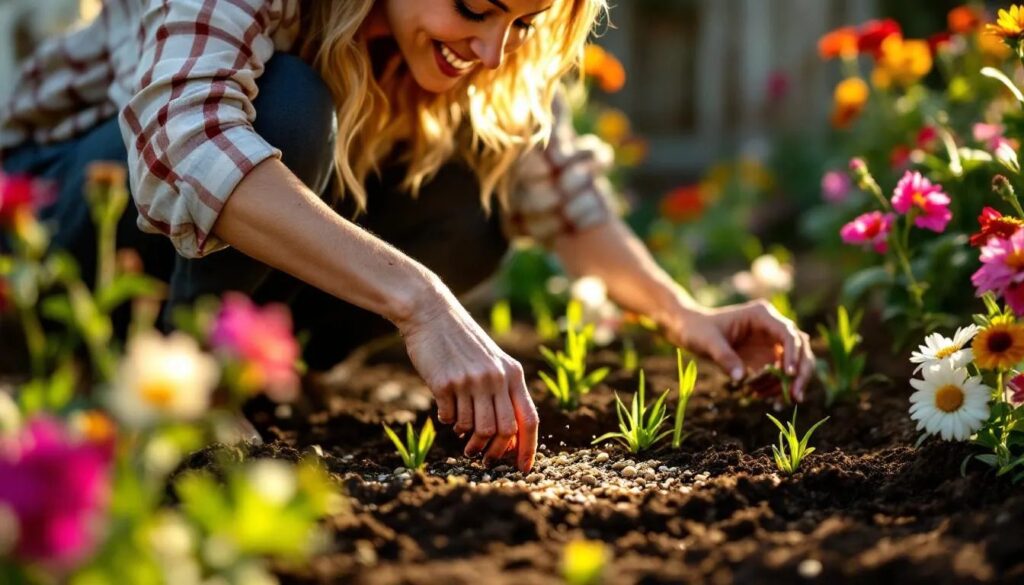
Wildflower seeds are notoriously fine and difficult to distribute evenly. Mixing them with dry silver sand at a ratio of roughly 1 part seed to 3–4 parts sand gives you visual coverage — you can see where you have already broadcast — and helps prevent over-dense sowing in some patches and bare gaps in others. Avoid builder's sand, which can contain salt residues harmful to germination.
3. Broadcast in two directions
Divide your seed-and-sand mixture in half. Scatter the first half walking across the plot in one direction, then scatter the second half walking at a right angle to the first pass. This cross-hatching technique ensures even coverage across the entire area. Sow at the rate recommended on your seed packet — typically 1–3 g per m² for most mixes. Resist the temptation to sow more heavily, thinking it will produce a denser display; overcrowded seedlings compete with each other and are more susceptible to damping off.
4. Rake lightly and firm
Rake the surface very gently, just enough to bring a thin layer of soil over the seeds. Most wildflower seeds need light to germinate, so the covering layer should be no deeper than 2–5 mm. After raking, firm the surface again lightly with the back of the rake or by tamping with a flat board. Seed-to-soil contact is the single most important factor in successful germination.
5. Water carefully and wait
If rain is not forecast within 24–48 hours, water gently using a fine rose attachment on a watering can. A strong jet will move seeds around and break up the prepared surface. The soil should be evenly moist but not saturated. Once watered, leave the plot undisturbed. Early germination can appear within 7 days in warm, moist conditions; some species take three weeks. A thin dusting of green across the surface is the first sign of success.
The professional's tip
If slugs are a known problem in your garden — and in a wet spring they almost always are — scatter a wildlife-safe slug deterrent around the perimeter of your sown patch before seedlings emerge. Young wildflower seedlings, particularly poppies and cornflowers, are extremely vulnerable in their first two weeks. By late March, slug activity is already increasing as soil temperatures rise, so acting before you see damage is far more effective than reacting afterwards. Iron phosphate-based pellets are considered safer for hedgehogs, birds, and pets than metaldehyde alternatives.
Aftercare and long-term management
Once seedlings are visible, thin them if necessary to avoid overcrowding — aim for roughly 5–8 plants per 30 cm² for annual mixes. Water during prolonged dry spells in spring, but reduce irrigation as summer arrives; wildflowers are drought-tolerant once established and overwatering encourages leafy growth at the expense of flowers.
At the end of the season, resist the urge to cut everything down immediately. Leave seed heads standing through autumn — they self-seed for the following year and provide food for birds. Cut back to ground level in late autumn or early winter, and the cycle begins again naturally.
Expanding the project
A wildflower patch does not need to be a dedicated meadow. Sowing into gaps between paving stones, along the base of a fence, or in raised beds all work well with the right seed selection. For shadier spots, choose a woodland edge mix featuring Digitalis purpurea (foxglove) and Geranium pratense (meadow cranesbill) rather than sun-loving annuals. Container sowing is also effective — a large terracotta pot sown in March with a compact annual mix can be flowering on a patio or balcony by June.
In the UK, no planning permission is required for wildflower sowing in private gardens. However, if you are managing a verge, a shared green space, or a plot near a nature reserve, check with your local authority before introducing non-native species, as some mixes sold commercially contain cultivars not native to the region.
| Seed type | Sowing window | First flowers | Estimated cost per 25 m² |
|---|---|---|---|
| Annual mix (cornflower, poppy, phacelia) | Late March–May | June–July | £5–£12 |
| Perennial mix (oxeye daisy, yarrow, scabious) | March–April or September | Year 2 | £8–£18 |
| Native meadow blend (annual + perennial) | Late March–April | Year 1 (annuals) + Year 2 (perennials) | £10–£25 |
Frequently asked questions
Can I sow wildflowers on top of existing grass?
Direct sowing into established grass very rarely succeeds. The existing sward outcompetes seedlings for light, moisture, and nutrients before they can establish. For best results, strip the turf or scarify the area heavily to expose bare soil before sowing. If you want to introduce wildflowers into an existing lawn, plug planting with pot-grown perennial species in autumn is a more reliable approach than direct seeding.
What is the minimum area worth sowing?
Even a square metre of bare ground is worth sowing. A small patch of cornflowers and poppies beside a path or along a wall edge can attract pollinators and add colour from early summer. For a more naturalistic meadow effect, a minimum of 4–5 m² allows enough visual density to read as a deliberate planting rather than an accidental patch.
Does the seed need to be kept moist until germination?
Yes. The period between sowing and the emergence of the first true leaves is the most critical. If the surface dries out completely during this window, seeds can abort germination mid-process — a condition sometimes called false germination. In a dry spring, a gentle watering every two to three days is enough to maintain surface moisture without waterlogging. Once seedlings are 3–4 cm tall, their root systems are deep enough to access moisture from lower in the soil profile.
My seeds germinated but the seedlings look leggy and pale — what went wrong?
Leggy, pale seedlings almost always indicate insufficient light combined with too much moisture or nitrogen. This can happen if the patch is partly shaded, if the seed was covered too deeply, or if you sowed into soil recently enriched with compost or fertiliser. Wildflowers actively prefer poor, lean soils — avoid adding any organic matter before sowing. If the plot is shaded for more than four hours per day, switch to a woodland or partial-shade mix better suited to those conditions.
Can I sow in April or May if I missed the March window?
April is still excellent — in many parts of the UK and northern Europe it is actually the peak sowing month, as soil temperatures are more reliably above 10 °C. May sowing works for annuals but produces later flowering, typically August rather than June. By late May, weed competition increases noticeably, so thorough ground preparation becomes even more important. Perennial species are better saved for an autumn sowing if the spring window has passed.